
Projected vs Actual Release Date
IDOC calls anticipated prison exit the Projected Parole Date and the expected end of sentence or supervision the Projected Discharge Date. After prison release, an actual Parole Date may appear while discharge remains later or undetermined. A pretrial detainee has no sentence-based date.
Find McDonough Projected Release Dates
IDOC is not a county-jail archive. Classify custody before reading dates.
- Search the IDOC portal by last name, IDOC number, or birthdate.
- Confirm identity and read Offender Status and Location first.
- Compare Projected Parole Date, actual Parole Date, and Projected Discharge Date.
- Read every sentence row and locate COUNTY: MCDONOUGH.
- For county custody, obtain the judgment and custody-credit order, then ask the jail to confirm its calculation.
Good-Time Credit and How Release Dates Are Computed
730 ILCS 5/3-6-3 is offense and offense-date specific. Eligible terms may receive day-for-day credit. Listed offenses may receive 4.5 days per month, often described as about 85 percent service, or 7.5 days per month, about 75 percent. Other terms may require full service. Earned credit can have exclusions, caps, loss, and restoration rules, so a simple percentage is unsafe.
Why a Projected Release Date Changes
A projection changes as lawful credits and custody events are posted.
| Factor | Effect |
|---|---|
| Custody credit | Credits time already served |
| Concurrent or consecutive terms | Changes combined term |
| Credit gain or loss | Moves the forecast |
| Detainer or warrant | May cause transfer, not community release |
| Court amendment or violation | May alter the sentence or supervision time |
Confirming a Release Date
Register with Illinois VINE for a custody change, then confirm the event with IDOC, the jail, or the court. The VINELink Release Check explains alerts. IDOC public search help is 217-558-2200; the jail line is 309-833-5245.
McDonough IDOC Sentence Rows
Each mittimus row has its own SENTENCE DISCHARGED?: YES/NO flag. An old YES does not prove release when the top status remains IN CUSTODY or a later row is active.
View the official field example.
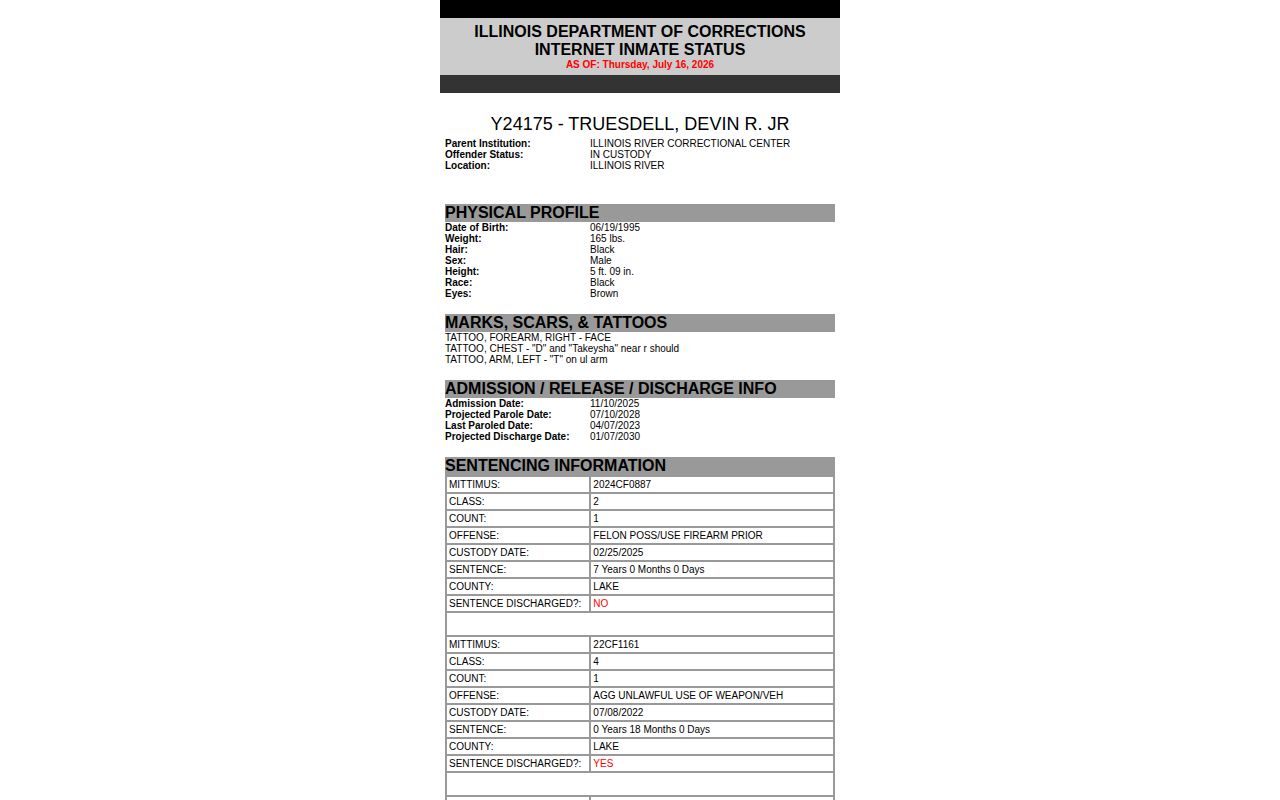
The example shows field placement, not a McDonough subject selected for publication.
McDonough Parole and Discharge
Illinois exposes two projections because prison exit and final discharge differ. PAROLE plus an actual Parole Date supports release to supervision. The later discharge date marks the expected end of jurisdiction and may remain TO BE DETERMINED. A transfer from McDonough County Jail to IDOC is also not community release.
Projected Parole Date should not be described as a guaranteed release date or proof of a favorable board decision. Many modern determinate sentences move into mandatory supervised release by law, while the Prisoner Review Board handles separate classes of hearings and conditions. The IDOC label must be quoted accurately without assigning it a broader meaning.
Compute McDonough Prison Projections
A lawful projection begins with the judicial sentence. It is not created by multiplying the sentence by a percentage found online. Relevant inputs can include the custody date, presentence credit, whether terms run together or one after another, the date of the offense, the statutory credit category, program-credit eligibility, disciplinary loss or restoration, violation time, and later amendments.
A careful reading sequence starts with each sentence and its custody date. Next, identify concurrent or consecutive language and the statute in force for the offense date. Apply only court-awarded or agency-recognized custody credit. Then determine which sentence credits are legally available and whether a minimum-service floor applies. The agency’s displayed result remains provisional until an actual parole, release, or discharge event is recorded.
Additional earned credit is never automatic. Statutory exclusions, caps, and minimum floors may limit it. Eligible credit can be awarded later, and credit can also be denied, revoked, or restored through applicable procedures. A changing date does not necessarily mean the portal made a mistake; the underlying inputs may have changed.
McDonough County Jail Calculations
A county-jail sentence follows the local judgment, custody-credit order, and jail calculation. IDOC’s displayed prison fields and credit rules should not be applied mechanically to a short county term. Time spent in custody before sentence, time outside custody, sentence units, lost or awarded time, and the actual terms of the order can all matter.
The McDonough Circuit Clerk can supply the sentence and custody-credit order. The jail owns the physical custody record and should confirm its projected discharge calculation. Ask for the booking or case number, sentence received, credit applied, and current calculation rather than asking staff to produce a new legal opinion.
McDonough County Jail110 S. McArthur St.
Macomb, IL 61455
309-833-5245
No primary source established a McDonough weekend-release rule, holiday adjustment, standard release hour, or public exit. Those gaps must remain open. Another Illinois county’s practice cannot be substituted.
McDonough Detainers Change Release
A date can mark the end of one custodian’s authority without proving release to the community. McDonough County Jail holds people for other jurisdictions, according to the official inspection. A person whose local sentence ends may be returned to another county, delivered to IDOC, moved under a federal warrant, or transferred on an immigration detainer.
Ask the jail record for the destination or receiving agency. If it says IDOC, allow processing time and then search the statewide person record. If it says federal or USMS, use the federal docket and holding facility before BOP intake. If it says ICE, use the A-number or exact-name route in ICE’s locator. A transfer should never be captioned as freedom merely because the McDonough custody entry closed.
Verify McDonough Actual Release
A reliable confirmation combines the calculation source with the completed-event source. For state prison, read the IDOC top-level status and actual Parole Date. For the county jail, obtain the discharge or transfer entry. For a local legal event, compare the entered court order. VINE can add a timely alert but does not replace those records.
- Save the agency result and its visible update time.
- Confirm whether the event says release, parole, discharge, or transfer.
- Check the destination and any remaining hold.
- Compare the event with the court or sentence record.
- Contact the responsible custodian if fields conflict.
IDOC can be reached at 217-558-2200 for public search help. For documentary confirmation beyond the portal, written requests can go to the IDOC Public Information Office, 1301 Concordia Court, P.O. Box 19277, Springfield, IL 62794-9277.
McDonough Court Date Evidence
The court file explains why custody should change. It may contain the judgment, sentence, custody credit, probation disposition, dismissal, pretrial-release order, or mittimus committing the person to IDOC. It does not always show the minute when jail staff completed physical processing.
A daily docket is a navigation aid, not the final order. A hearing can be continued, vacated, or followed by an order entered later. Obtain the official order from the McDonough Circuit Clerk and reconcile it with the jail record. A dismissal in one case does not resolve a different warrant or hold.
For a named person, avoid reconstructing a projected date when the agency itself does not display one. A portal value of TO BE DETERMINED means the public record does not support a final answer.
The clerk case number links court and custody sources. Use it when asking whether the jail received an order, whether another hold remained, and whether the disposition sent the person to probation or IDOC. A mittimus explains commitment to state custody rather than release. A time-served order may explain legal authority but still needs the jail completion timestamp.
Historical confirmation can require both records. The court order survives after a person leaves any current-custody display, while the jail register preserves the discharge or transfer event subject to retention rules. McDonough’s exact jail-register retention item was not verified. Ask the FOIA officer for the applicable Local Records Commission schedule rather than inferring that an old event never occurred.
Request McDonough Date Records
A focused request asks for existing documents instead of requiring staff to calculate a new answer. Give the name, booking or IDOC number when known, date range, and case number. For the county jail, request the booking sheet, sentence information received, custody-credit entry, projected calculation if maintained, and final discharge or transfer record.
Send county requests to FOIA Officer Bailey Rauch, McDonough County Sheriff’s Office, 110 S. McArthur St., Macomb, IL 61455, or brauch@sheriff.mcdonough.il.us. Illinois FOIA normally requires a response within five business days and permits a written extension of up to five more for statutory reasons.
The first fifty ordinary black-and-white pages are generally free; later pages may cost up to fifteen cents each. No special McDonough projected-date fee was found.
McDonough Date Reading Checklist
Before relying on a date, confirm identity, custody system, whether the date is projected or actual, which sentence row it belongs to, and whether a transfer or hold follows. Save the source date because online values can change.
Does projected discharge prove prison release? No. It concerns the expected end of sentence or supervision. Projected Parole Date addresses anticipated prison exit, while actual Parole Date records a past event.
Federal Release Date Boundaries
A BOP projected date belongs to a different federal system. BOP warns that First Step Act credit review can change a displayed date. Released or Not in BOP Custody means only that BOP no longer holds the person; another authority or federal supervision can remain. Do not merge that label with IDOC fields.
ICE has a separate recent-custody locator, and USMS has no general public release search for ordinary prisoners. When a McDonough record shows a federal transfer, follow the named authority rather than interpreting an IDOC no-result. Custody classification remains the first step in every date lookup.